Monday, June 9, 2014

St. Lucia (3) Morne Coubaril Plantation

 Morne Coubaril Plantation House
Morne Coubaril is St. Lucia's oldest French Creole estate. And it is still a working plantation.
 The entrance way is lined with bougainvillea.
 Walking Palm, commonly called the walking tree, does and does not "walk" through the jungle. When the palm meets some obstacle, new roots grow and the ones behind die. Thus, a tree may move three feet in one year.
Certain connoisseurs will immediately recognize this tree. The COCOA tree.
This working estate still grows cocoa, coconuts, and manioc.
 For me, one of the highlights was the explanation of the processing of the cocoa bean.
 The cocoa is fermented, dried on racks in the sun, polished by "dancing" on them, crushed, then formed into chocolate sticks.
 Fermented. Look under the table by the wall. At least something was fermented in there.
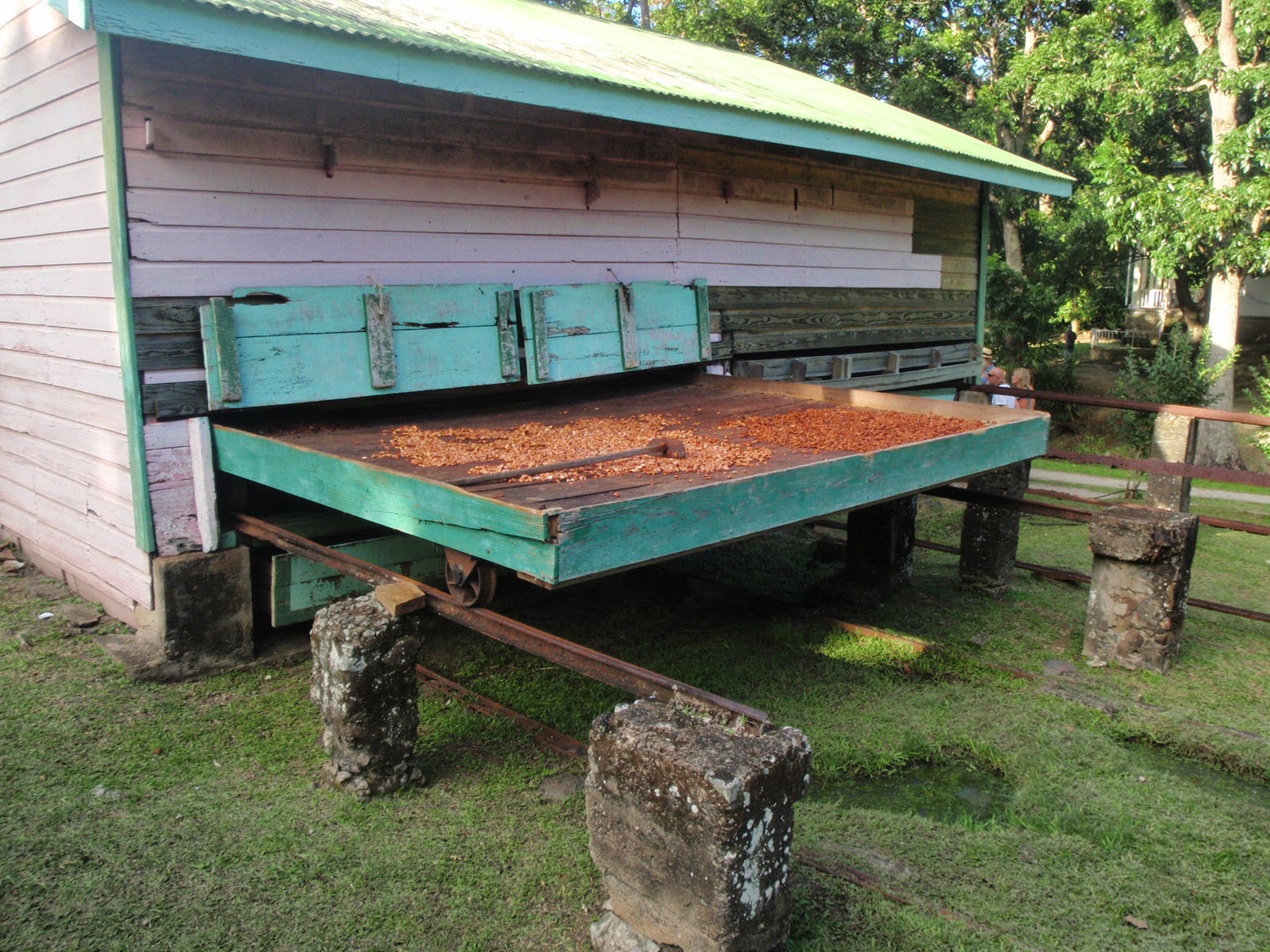
 Dried in the sun on a rack.
 And polished by dancing on them.
Then crushed.
The only thing wrong with the tour and explanation of the processing was that we didn't get to sample the chocolate sticks.
 
 Next we were shown how coconuts are opened.
Coconuts are opened the same way at the Polynesian Culture Center in Hawaii. We never have been told if the method was passed from island to island or if the method was instinctual. The difference: this man used an iron spike and in Hawaii they used wooden stakes.
Whereas I whined that we didn't get a chocolate stick from the other exhibition, this one let people drink the coconut milk and had pieces of coconut for one to sample.
 Time to walk around again. Bay view from the point.
 Peaceful.
 Another bay shot.
 There were old huts to show the way "villagers" used to live.
 I forgot to look closely at this interior shot. I bet the sewing machine was a Singer.
 One room efficiency?
 This one at least had two rooms.
 All good hostesses know the way to keep people happy is to feed them. I don't remember what the choices were but I do remember being pleased. Must have been desserts.
 Stomach full, it was time to walk around again.


 It was getting late and around quitting time. These horses were headed for the barn without having to be told.
 About quitting time and one tired, happy tourist.
 If one recalls, we docked in Castries and then took an all day tour of the island. We ended at Soufriere. Logistical problem? No. The ship left Castries and sailed along the coast to Soufriere to pick us up. The passengers had some great coastal scenery and we had some interior scenery. We were picked up by a tender and ushered to the ship.
And a fond farewell to the Gros and Petit Pitons.


Monday, June 2, 2014

Touring Bosque County

 Bosque County
Home of Bosque Tour de Norway and "The Norwegian Capital of Texas".
 Clifton is a quaint town settled by Norwegian immigrants in the mid 1800's. They are proud of their heritage, and on the day we visited Norwegian flags lined the streets in honor of the Constitution Day of Norway. 
 Clifton has a great little museum with historical artifacts, period displays featuring the above diorama.
The display, called the Horn Shelter, portrays the burial of a man and girl as it took place 11,200 years ago. Burial goods consisted of items such as turtle shells, deer antler tools, bird and animal claws, coyote teeth, and bird shells. With so many items at the burial site, it is thought that the man and child were important.  
Horn Shelter Man
A facial reconstruction of the man found in the burial site. According to the Smithsonian Institute, he is not related to the American Indians. The origin of the man and child is still being researched.
Just on the outskirts of town is the 1884 Whipple Truss Bridge. Whipple is the engineer who designed the bridge. A "truss" is a structure comprising of five or more triangular units constructed with straight members whose ends are connected at joints referred to as nodes. Of course, I knew that at the time I was taking the pictures.

The Whipple Truss bridge spans the Bosque River.
Construction of the bridge opened up travel routes from the south and west to the north and east. The bridge provided an important transportation connection for Bosque County residents from 1884 to 1941 when traffic was routed west of the Bosque River to the newly constructed Highway 6. The bridge is still being used as of this date. It did not creak or grumble as we crossed over.

Time out for the Indian Blanket wildflowers.
The Cliftex has the distinction of being Texas's oldest, continuously operating movie theater. It has been in business since 1916.
We ate at a great little place called Sulak's. We had called ahead so they reserved a parking place for us.
Our Savior's Lutheran Church was the location of our first rest stop on the tour. 

The church was organized in 1869 and still holds services today.
The cemetery on the church property serves as the burial site for a number of original Norwegian settlers of the area, including Cleng Peerson, considered to be the "father' of Norwegian immigration to the United States. Recently a monument was constructed just outside of the church's cemetery recognizing the 17 original Norwegian settlers of Bosque County. Interestingly, Cleng is not depicted on the monument.
St. Olaf Kirke
The St. Olaf Kirke (church in Norwegian) is commonly known as the "Rock Church". It was built in 1886 from limestone quarried from the surrounding hills. The church was not on the 20 mile bike ride so Christine wanted to see what she had missed.

Altar area with heating stove.
The church was named after Olaf II Haraldsson, King of Norway from 1015-1028. He was canonized in 1030 as Saint Olaf.
Baptismal font.
Regular Sunday services are no longer conducted, but the church is popular for baptisms and marriages.

Originally the church's floor was dirt, and the pews were constructed of planks laid upon wooden kegs. Today's pews are a lot more comfortable. I thought they leaned back, thus when one became drowsy, his head would fall back and wake him up (with ours, my head falls forward and Christine has to wake me up).

Upon time to depart, bikers started to roll in. Every third Saturday, a Community and Bikers Service is held.  
The Llamas were still in their pasture across from the church.
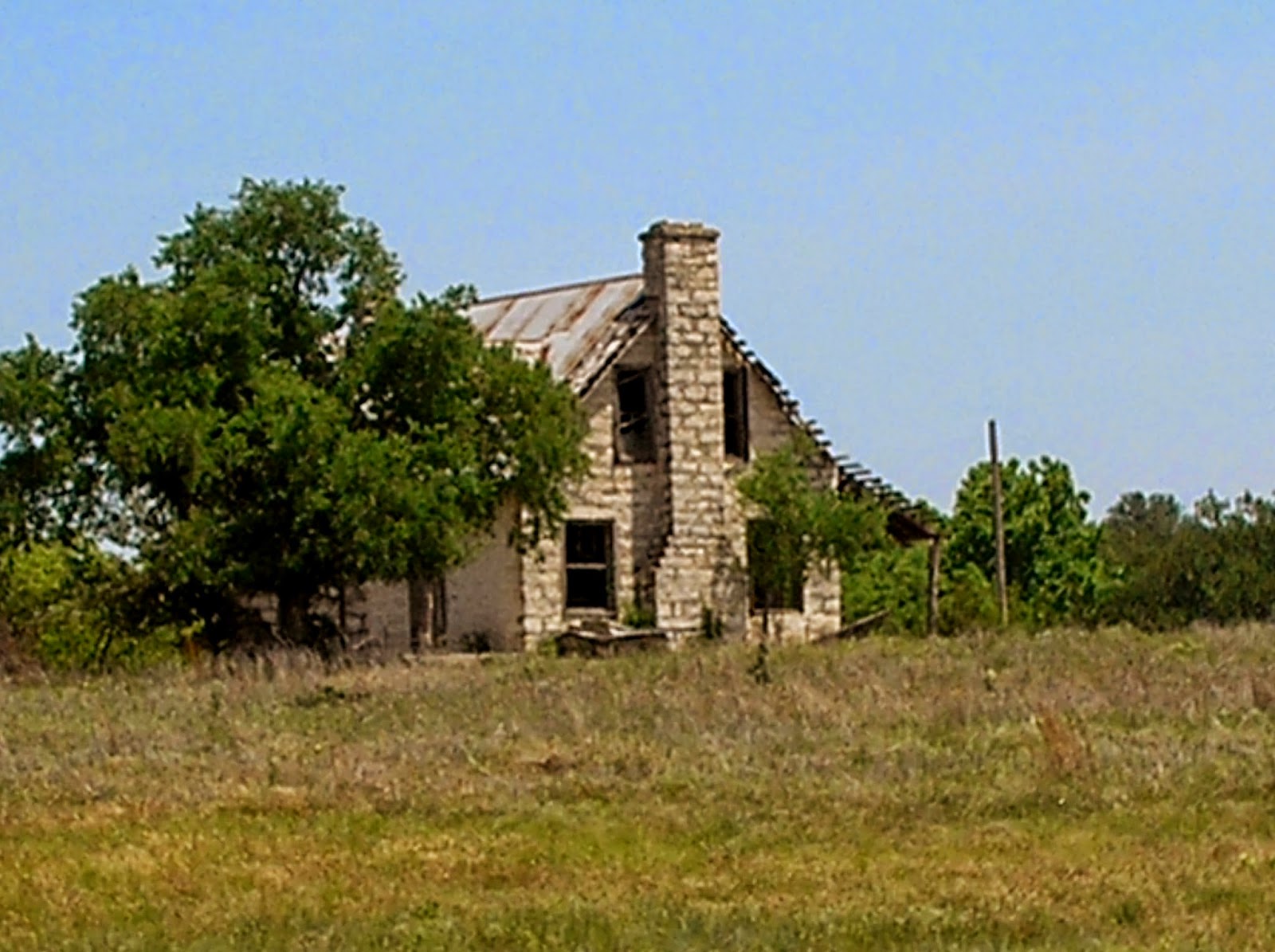
In case someone is interested in moving to Clifton on the cheap, there are a couple of fixer-uppers along the route.

On the fence in front of one of the fixer-uppers were some wild grapes. A good snack while renovating your new quarters.
The tour was fun. The area very interesting. Hopefully we will return again and again.